
















The Meadows Apartments on the northwest corner of the SDSU campus has had issues in the past for air quality concerns.
In December 2024, Collegian Media reported a story on what students described as “mold” found in air ducts in the complex. However, university officials did not confirm the presence of mold.
A Collegian Media article from December 2024 said work was done in late September 2024 when the university hired INTEK Cleaning and Restoration to clean the air ducts. Air quality tests were conducted by the university, according to the Collegian Media article.d
These reports were not the first concerns raised about the air quality at Meadows.
The Meadows apartment complexes were built in 1994 and originally named Berg and Bailey Halls. Mold was discovered in 2001, according to a 2001 Associated Press report. The report said mold was found in water pipes, air vents and inside living spaces.
Another mold outbreak was reported in September 2018.
This occurred after renovations were done and the building names were changed to Meadows South and Meadows North. Collegian Media reported 15 units were affected by mold. Several students moved out entirely as a result. Meadows was renovated again in 2020 to replace the heating, ventilation and air conditioning system.
Why mold is an issue in residences
Certain environmental conditions can favor mold growth, explained microbiologist Nina Herrera.
“Mold is usually developed in some sort of moisture,” said Herrera, who works as a microbiologist at SDSU. “It has to have some sort of food source, and so a lot of cases when we think of mold, it’s going to be in drywall, carpets, those types of structures and starchy materials.”
Mold can also be introduced from outside sources. An action as innocent as walking through dirt could bring in mold unknowingly to a building. Most mold naturally produce mycotoxins which can have negative health effects, and they can appear around three to seven days after exposure to moisture. Similar to allergies, symptoms of mold exposure include headaches, migraines or congestion. Mold can also affect people’s moods as “it can dilate your brain differently,” Herrera said.
Not all molds release toxins, but Herrera said it is best to address any potential mold. If caught soon enough, the mold may not have time to release any toxins. She said mold clean up is not as simple as some people might think.
“In most cases, with those types of things, you would have to physically remove it,” Herrera said.
Back home in Meadows
Other students expressed concern over possible mold in Meadows. When agricultural communications major Marissa Meyer moved into her apartment, a dehumidifier had been placed inside. She later saw what she describes as mold in her apartment.
“When we first moved into the apartment, we noticed that, in our dressers, there was mold in them,” Meyer said. “We thought that was kind of weird, so we just cleaned them out.”
Meyer said other students on her floor reported mold inside their vents and advised their neighbors to do the same.
“The (residential adviser) got really mad about that, and so she came knocking on our doors and was like, ‘there’s gonna be a mandatory meeting tonight about the alleged mold,’” Meyer said. “(RA) said that the people were calling it black mold, but ‘We can’t call it that because it’s not for sure.'”
Following the floor meeting, Meyer said the university conducted air quality tests in her apartment, which came back with acceptable results. One apartment “at the end of the hallway” had poor air quality. “Then they did come and clean out all of our vents, like the whole building got cleaned out,” she said.
Collegian Media requested an interview with Rebecca Peterson, Director of Housing and Residential Life, about the pattern of mold allegations in the Meadows complex. She responded with the following statement via email:
“As was shared before, Housing and Residential Life has made several significant recent improvements to the Meadows apartments including updating the heating and cooling systems, replacing the siding and new flooring,” Peterson said. “There is no new information to share at this time, and we still encourage all residents to communicate concerns to us directly so we can resolve them in a timely manner.”
Collegian Media’s petri dish tests
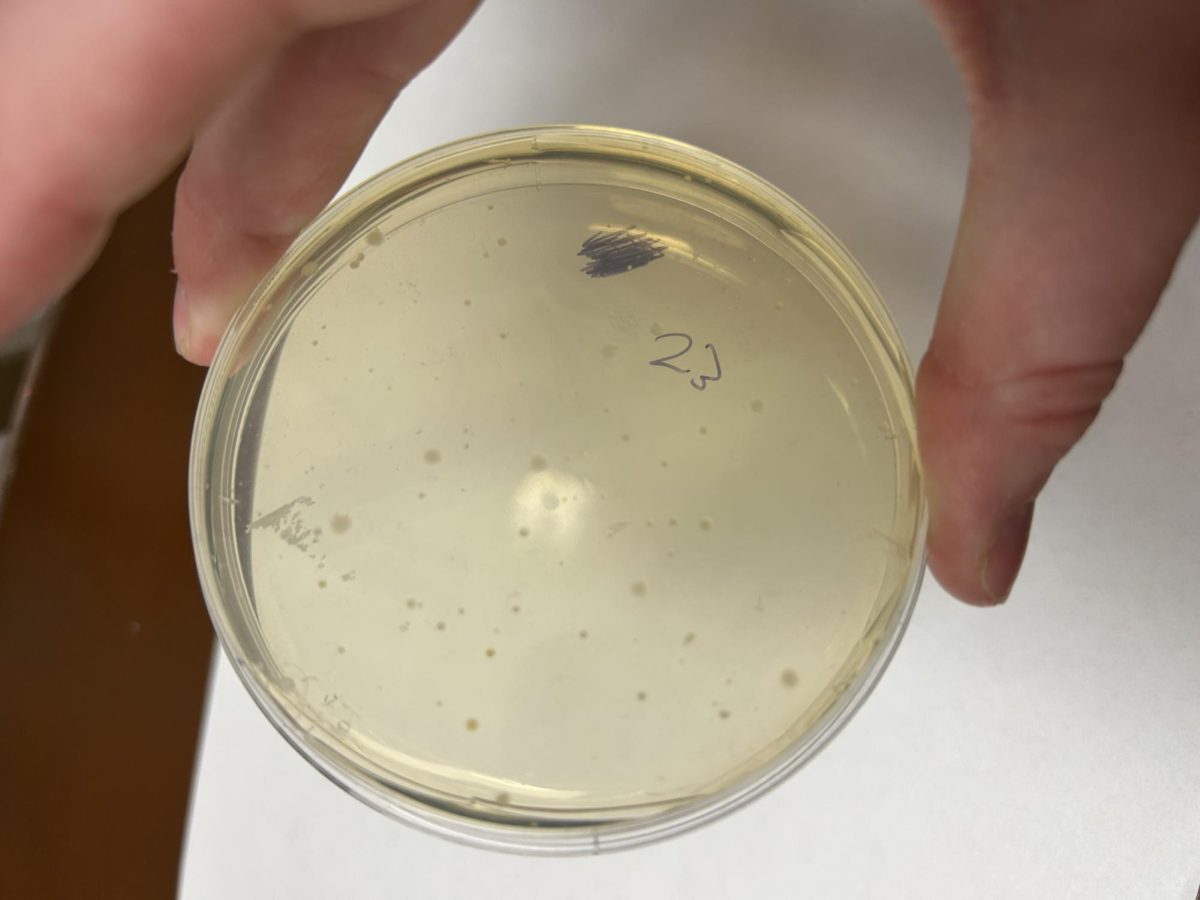
Collegian Media reporters placed six Petri dishes in the stairwells of the Meadows apartments, three each in Meadows North and Meadows South to examine the air quality. Five Petri dishes were recovered as one went missing from the second floor of Meadows South.
After the Petri dishes were incubated and examined, the dishes showed signs of bacteria but no black mold.
This story was reported and written by students in Watchdog Reporting class.
