


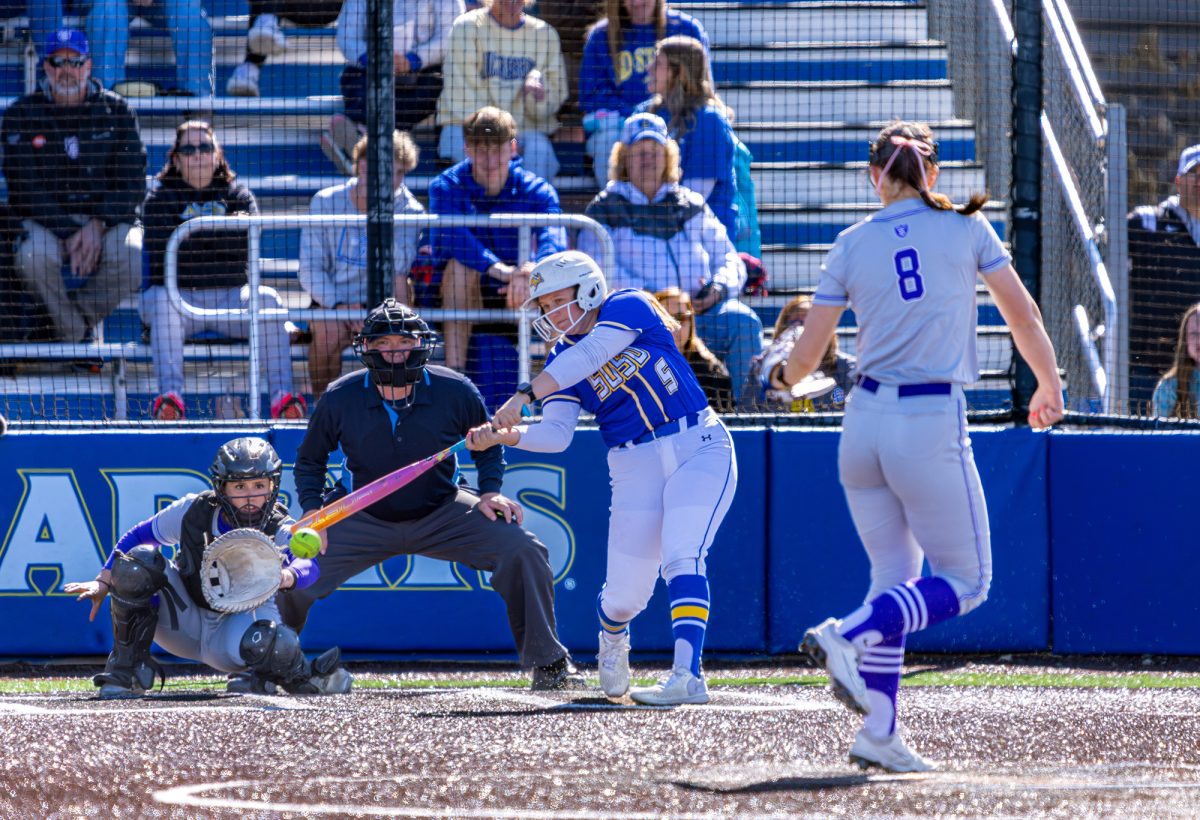

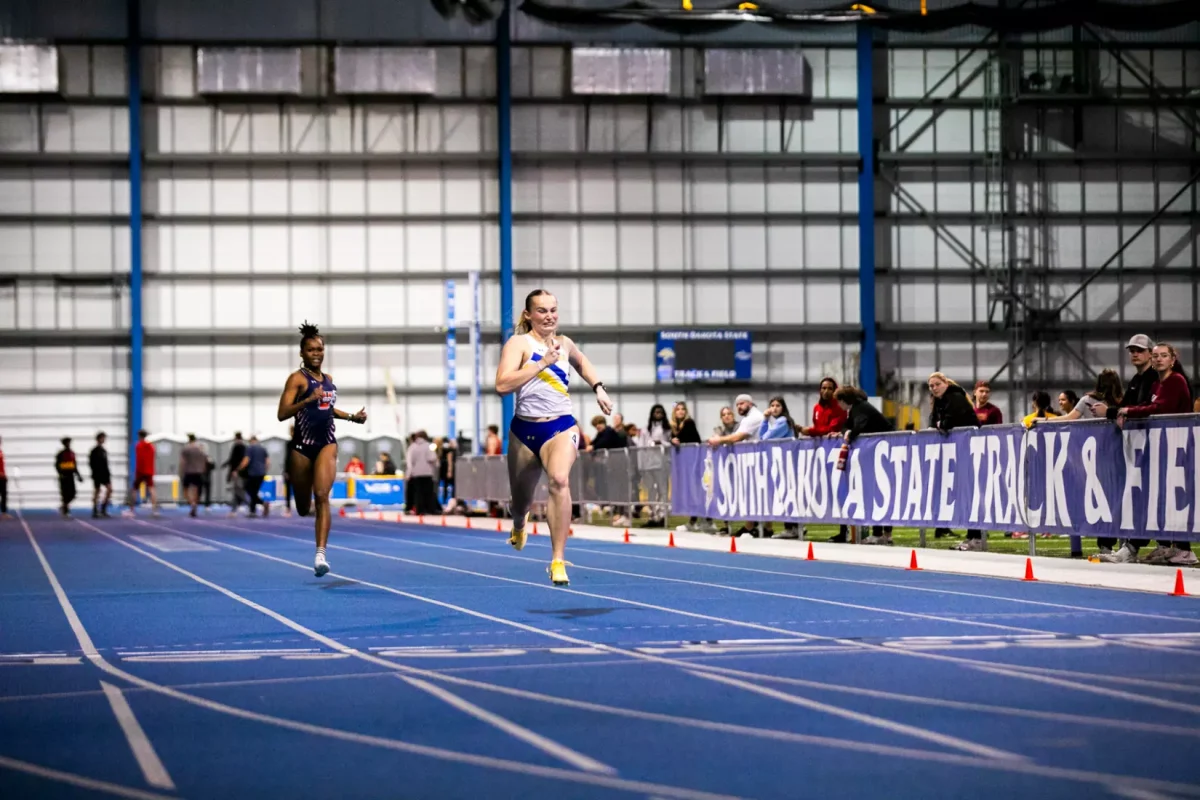









For the South Dakota State Jackrabbits softball team, managing academics and athletics is a daily grind that requires discipline, time management and drive to succeed both on and off the field.
The Jackrabbits are sitting just below .500 with a record of 23-24 overall.
“This season has had its ups and downs,” said Tori Kniesche, a former player and current pitching coach. “There have been a lot of positive and growing moments. They have been facing adversity and handling it well.”
The Jackrabbits spent their first 37 games on the road this year, and only nine of their 56 games will be played on their home field.
That raises the question of how they manage all of their schoolwork while being on the road so much.
“Our girls do a really good job of not letting being on the road affect them academically,” Kniesche said. “It can be a challenge, but it also motivates our players to get their work done so they can play.”
The student-athletes are held to a high standard in both the classroom and on the field. They are expected to have above a 3.0 GPA, and the team’s goal GPA is 3.5.
The team ended the fall semester with a 3.44 GPA, slightly below expectations. However, according to Kniesche, they have improved in the classroom this semester.
To improve academic performance, the players are expected to show up to every class they have in person when they are not away at a game, according to Kniesche. Even if they get home late from a game and have an 8 a.m. the next morning, it is non-negotiable.
They are also required to attend four hours of study hall when they are outside of season and two hours when they are in season. In addition to their mandatory study hall, hours are added if a player falls below an A in a class.
When on the road, the team has mandatory study time, whether that is during a long bus ride or in a conference room at the hotel.
“We are on the bus for eight to 10 hours sometimes, so that is a great time to get stuff done,” said Akayla Barnard, junior pitcher and outfielder. “When I am motivated, and I know I need to get something done, I get it done.”
Accountability plays a major role in this kind of setting.
“Iron sharpens iron both on and off the field,” said Alli Boyle, fifth-year senior first baseman. “We put good work in when it’s time to work.”
The players have many people in their corner. Coaches, professors and advisors all work hand in hand to make sure the players have what they need to be their best on and off the field.
“We have them fill out every assignment for every class, day by day,” said Kniesche. “This helps them stay more organized and to help track their progress. We also meet with them one-on-one to make sure they aren’t struggling.”
If the players are struggling in their classes or with their schedule, they meet with the team’s academic advisor, who is always there to help the athletes.
“The SDSU professors work really well with our athletes,” said Kniesche. “The girls do a great job communicating with them, and the professors are flexible.”
Along with helping the players succeed in the classroom, the professors are helping prepare student-athletes for the future.
The support extends beyond the classroom, helping prepare student-athletes for life after college.
“Every professor that I’ve had has gone above and beyond to apply their teaching to what I want to do,” said Boyle. “And that has helped me the most.”
Being a student-athlete comes with many challenges, but those challenges turn into valuable life skills that players will carry with them into the real world.
“Being a student-athlete has pushed me in and out of the classroom,” said Barnard. “Doing all three positions can be very hard, but it has taught me so many life lessons outside of softball.”
Kniesche stated that time management is one of the biggest skills the players will take with them beyond college.
For players like Boyle, the challenge is what makes it all worth it.
“Being a student-athlete is one of the hardest but most rewarding things I will get to do in my life,” Boyle said.