



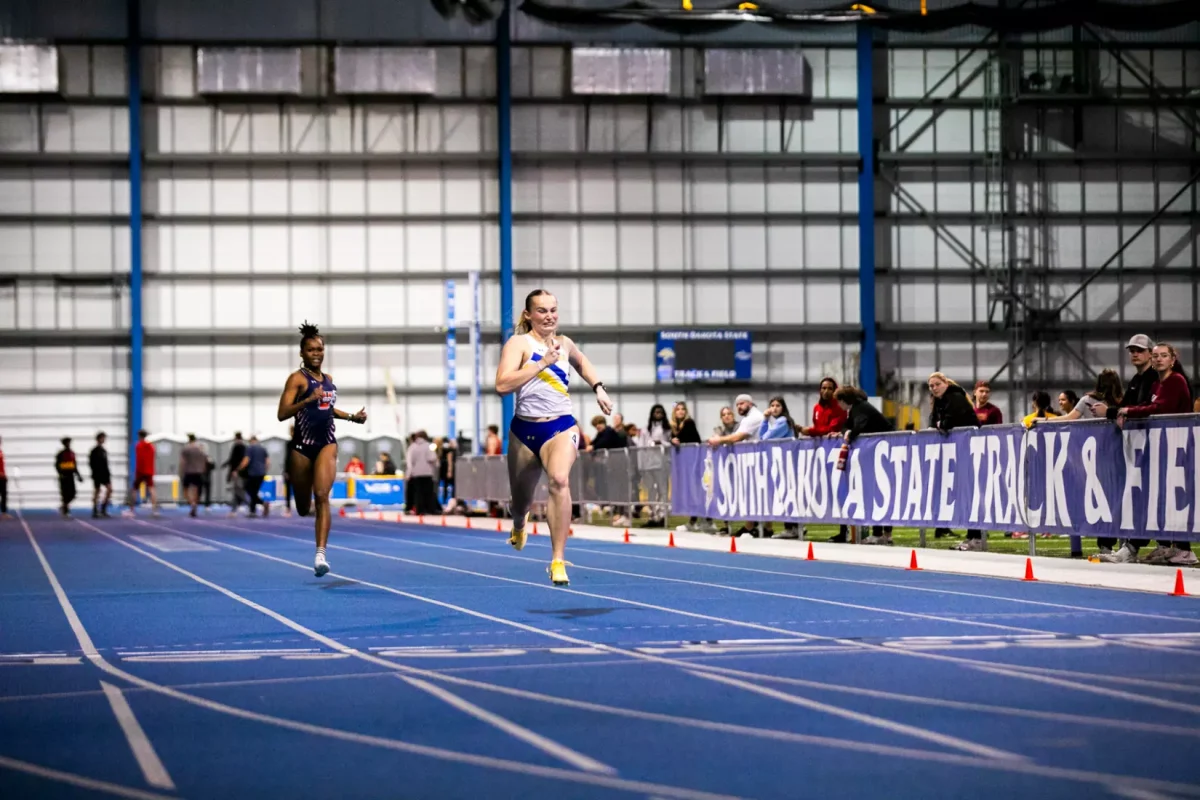









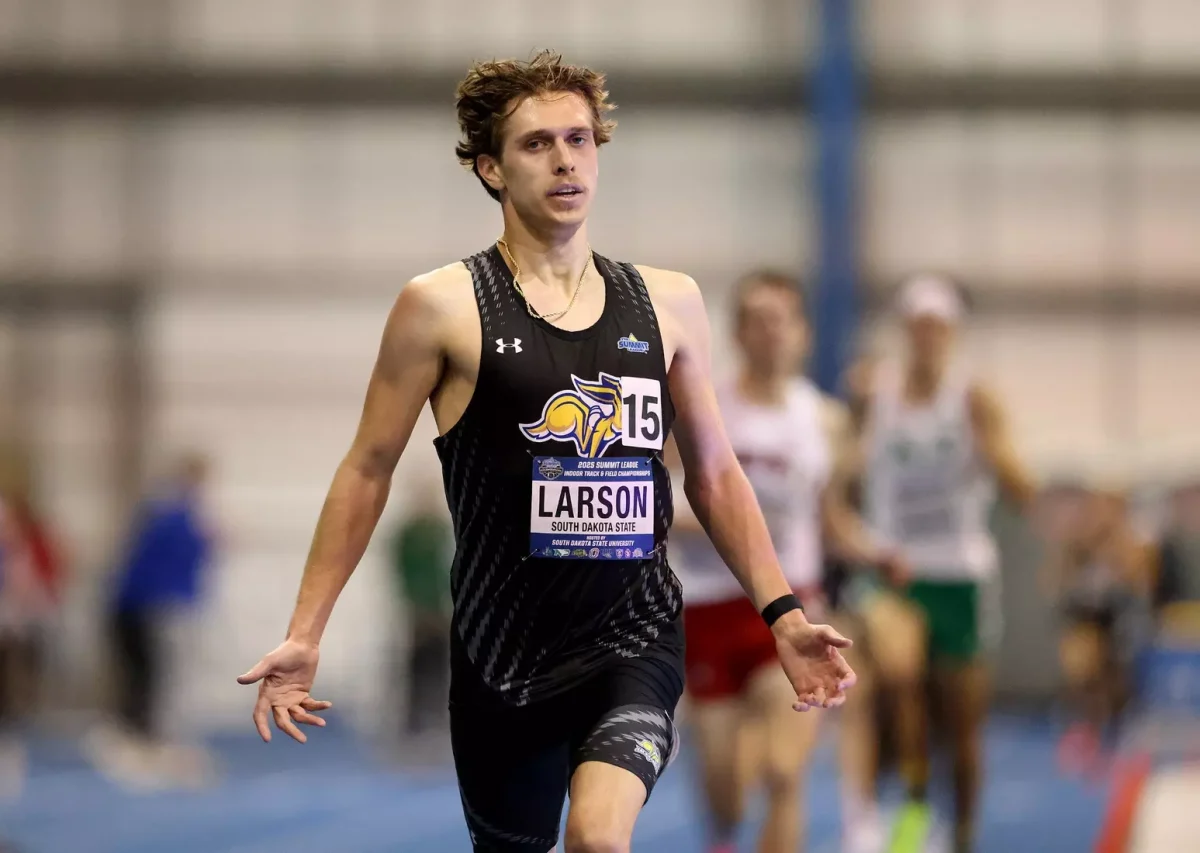
The fastest member of the SDSU distance track team has competed at NCAA DI Cross Country and Track Nationals, holds multiple SDSU records and was first in the Summit League and 98th in the nation in the 2025 season of cross country.
Would you believe he “hates running?”
Cody Larson’s distaste for running means his teammates often have to drag him out the door to go on runs, SDSU track and field and cross country head coach, Rod DeHaven, said.
“He always tells me he hates running,” teammate and fellow distance runner, Jackson Dutcher, said. “I’m like, dude, you don’t hate running. You do it all the time. Like, how can you hate it?”
Larson spent years outside of the spotlight. The fifth-year senior and a mechanical engineering student’s success has been a long time in the making, Dutcher said.
Larson graduated from Warner High School in Northeast South Dakota as a dual-sport athlete in wrestling and cross country. He had a time of 15 minutes, 48 seconds in the 5K in high school. While it’s certainly not slow, it’s nowhere near as fast as his current record of 13:48.
“There’s a metaphor about a bamboo sprout. For eight years, it’s below the ground. And then when it finally sprouts, it grows 8 feet in a week. That’s kind of like Cody,” Dutcher said. “He was good at running, but not like, 13:48, 8:30, steeplechase good.”
“It kind of just seemed like it was out of nowhere,” Dutcher added. “But behind that, he’d been running consistently, doing workouts for years and years and years.”
To get to the success, Larson first had to spend a few years ‘below ground.’
“What’s special about Cody isn’t just where he is now, I think it’s the highs and lows he’s gone through,” said redshirt junior Will Lohr, another of Larson’s cross country teammates.
DeHaven said there’s often an “adjustment period” that comes when student athletes go from high school to college athletics.
“Student-athletes are expected to perform better than they did in high school, and their lifestyle habits are expected to go above and beyond a typical college student. Better sleep, better eating, all leading to better racing,” DeHaven said.
Larson has battled injuries and low iron levels, leading to energy deficiency. He also was the first considered out of contention for one of 10 spots to run at the conference meet his sophomore year. He said it was one of the biggest “lows” in his career at SDSU.
Another low for Larson was a fall in the 2025 NCAA 3,000-meter steeplechase race. He fell after having great placement with two laps to go and missed the finals. Larson said it added “just more fuel to the fire.”
But he’s used these negative experiences to mold him into a better athlete and better teammate.
“I would say one thing about Cody is he’s definitely gone through his valleys,” Lohr said, “and all that experience has really shaped a broad perspective on the sport for him. He’s very good at sharing that with his teammates.”
Larson uses his mistakes to lead by example because he’s learned from his experiences. It comes in different forms – whether he’s listening to his body and not overexerting himself in a workout or “reminding other runners on the team, younger runners, just to be patient and keep showing up,” Dutcher said. Larson, and the experience he brings, is an integral part of the team culture.
Larson said using a lesson he learned from wrestling helps him while racing: A wrestler must know their first three moves before the match even starts. He uses this mindset to envision races and specifically beat opponents.
Dutcher said Larson “really likes to focus on the winning aspect of running.”
“I like to look around at the NCAA and call people runners or racers,” Larson said. Some people like running and pushing their bodies for the love of it, Larson said, but not him.
“I’m putting up with all this mileage and all this work to be able to compete with other people,” Larson said. “That’s why I got into the sport. To beat other people … I don’t care if I get 12th place. I don’t care if I have a really bad time as long as I win.”
And win he has. Larson has accolades to show for his work. In 2025 alone, he was named Summit League cross country athlete of the year, first team All-Summit League and was part of the NCAA All-Midwest finishers.
In 2024, he was named “Most Outstanding Male Performer” at the indoor Summit League track and field championships. He holds school records in the 3,000-meter race, the 5,000-meter race, and is a co-record holder in the distance medley relay. (maybe make breakout)
As much as he’s accomplished, there is still a lot left for Larson. DeHaven summed Larson’s goals up in a sentence. “Get to Eugene (Oregon, where the NCAA championships are held each year), get to the final and become an All-American.” To make first team All-American, a runner must finish top eight in their respective event.
Some NCAA running programs teams have started to bring athletes from overseas powerhouse distance running countries, such as Kenya, and put them in a few online classes to have them on the cross country team. These athletes are generally older than college students, and are more akin to professional athletes than collegiate athletes.
In 2026, of the top 20 finishers in the NCAA D1 Cross Country finals, 18 of the top 20 were foreign athletes. 58% of the top 50 were from Kenya alone. Despite these recruitment tactics making it harder for true college athletes to achieve this mark in NCAA track and field, Larson’s competitive edge drives him to see this not as a setback, but an opportunity to prove just how far he has come.
“I got to up my game,” he said. “It just makes me better as a whole. “That’s the kind of competition that you want to strive for, regardless of if it’s foreign or not.”