













A comment made during Monday’s Students’ Association meeting raised questions on if South Dakota State University’s equestrian program could be in jeopardy.
During committee reports, Sen. Regan Bollweg, who is an Intercollegiate Athletic Committee student representative, referenced a broader discussion about NCAA emerging sports list and long-term athletic planning.
“Something exciting that I heard, they’re looking forward to possibly new future women’s sports coming on campus, kind of if equestrian falls through with the recent news on that,” Bollweg said. “But the three that he (Justin Sell) said was flag football, stunt and lacrosse, were the three kind of options that athletic department officials are juggling.”
The phrasing prompted clarification from SA President Sophie Spier on if equestrian could “fall through.”
Bollweg replied: “Not what I was necessarily implying, but if it were to fall through – so I don’t think they plan on dropping it, but with recent news, kind of what I heard, not many questions were asked about it. But if equestrian falls through for some apparent reason, but I don’t want to spread any false narrative here.”
Even with the clarification, the exchange led to broader questions about the status of SDSU’s Division I equestrian program – and whether it would eventually disappear.
Athletic Director Justin Sell said on Tuesday the equestrian program isn’t going anywhere.
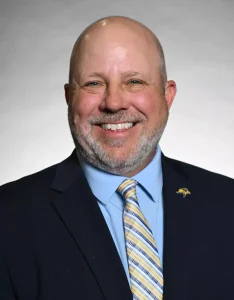
“We are fully committed to our equestrian program,” Sell said. “Our student athletes have done some great things, and we’ve done some great things to enhance their experience.”
Sell said the program is far from being cut.
“There is nothing at all that would say we don’t want to have equestrian fully engaged and going,” he said.
While SDSU officials say equestrian is stable locally, its national classification continues to shape the conversation.
Equestrian has been classified as an emerging sport since 2002. To move from emerging status to a full NCAA championship sport, 40 schools must sponsor the program at the varsity level. Now in its 24th year on the emerging sports list, equestrian remains short of that number.
There are currently 19 NCAA Division I programs and three Division II programs that sponsor the program at varsity equestrian through the National Collegiate Equestrian Association. An additional 24 Division III schools also sponsor the sport, but those programs do not count toward the NCAA’s 40 school requirement for championship status.
The University of California, Davis announced in January it will downgrade its NCAA Division I varsity equestrian team to club sport status in favor of elevating another emerging women’s sport to varsity this July.
That move raised some eyebrows about the future of the sport.
Lynn Hickey, executive director of the National Collegiate Equestrian Association, said Tuesday the decision at UC Davis has been difficult for those involved.

“Anytime you lose a program, it’s not something you want to go through. First of all, we feel bad for the student athletes,” Hickey said. “Secondly, there is a lawsuit in place now where the parents and supporters of that program are trying to stop the decision or delay it at least. I think we’re waiting to see what will happen with that.”
Hickey said the situation at UC Davis is still playing out. Reaching the championship status will depend in part, if Division III schools will be counted toward the 40 school mark.
Hickey said reaching championship status will depend on broader Division III recognition.
“We have enough NCAA schools sponsoring varsity equestrian currently to meet the 40-team mark – we just must first work to get Division III to embrace our sport as an emerging sport,” Hickey said.
If that happens, the sport would be eligible to request a vote at the NCAA convention for championship status.
In the meantime, Hickey pointed to signs of stability, including championship events hosted by the SEC and Big 12. She also said this year’s national championship will be broadcasted by ESPN+.
She noted the size of the equestrian industry nationally, mentioning there are over 7 million horse owners in the United States and more than 20,000 middle and high school students who compete in equestrian, creating what she described as a strong recruiting base for collegiate programs.
Still, equestrian remains short of the NCAA benchmark to hit championship status, a reality that has people wondering what the future of equestrian is.
Although national discussions about emerging sports can create uncertainty, Sell said those conversations do not signal change at SDSU. Instead, he said they reflect the kind of long-term planning athletic departments do.
Sell said SDSU studies emerging and growing women’s sports to stay prepared if participation numbers, conference alignment or NCAA policy were ever to shift.
“It’s really about just being prepared and knowing what’s out there,” Sell said. “We’re just open to understanding and continuing to study what’s out there with no intent right now of adding any sports.”
Among the women’s sports that have gained attention nationally are flag football, stunt and lacrosse. Flag football, in particular, has grown rapidly at the high school level and has recently become an Olympic sport.
Sell said adding any new sport would require extensive evaluation, including facility needs, roster sizes, scholarships, conference opportunities and budget impact. Participation numbers also factor into Title IX requirements, which requires fair athletic opportunities for men and women.
SDSU currently sponsors 19 varsity sports and has over 500 student athletes, making it one of the larger athletic programs in the Summit League.
“We’re pretty full with the opportunities that we have right now,” Sell said.
Because of that, Sell said discussions about other women’s sports are about preparation – not immediate expansion or replacement of existing programs. Monitoring sports such as flag football or stunt, he said, is part of staying informed in a college athletics landscape that continues to change.
Because equestrian remains classified as an NCAA emerging sport, its long-term status ultimately depends on decisions made at the national level.
“And honestly, the only factor at this point that would make it go away is something we don’t control. I mean, that’s an NCAA designation,” Sell said.


Brandon Schulz • Feb 25, 2026 at 9:53 pm
Excellent, would rather go to an equestrian match any day of the week over football.