















One SDSU alum is shaping the future of pharmaceutical development while giving back to the next generation of scientists.
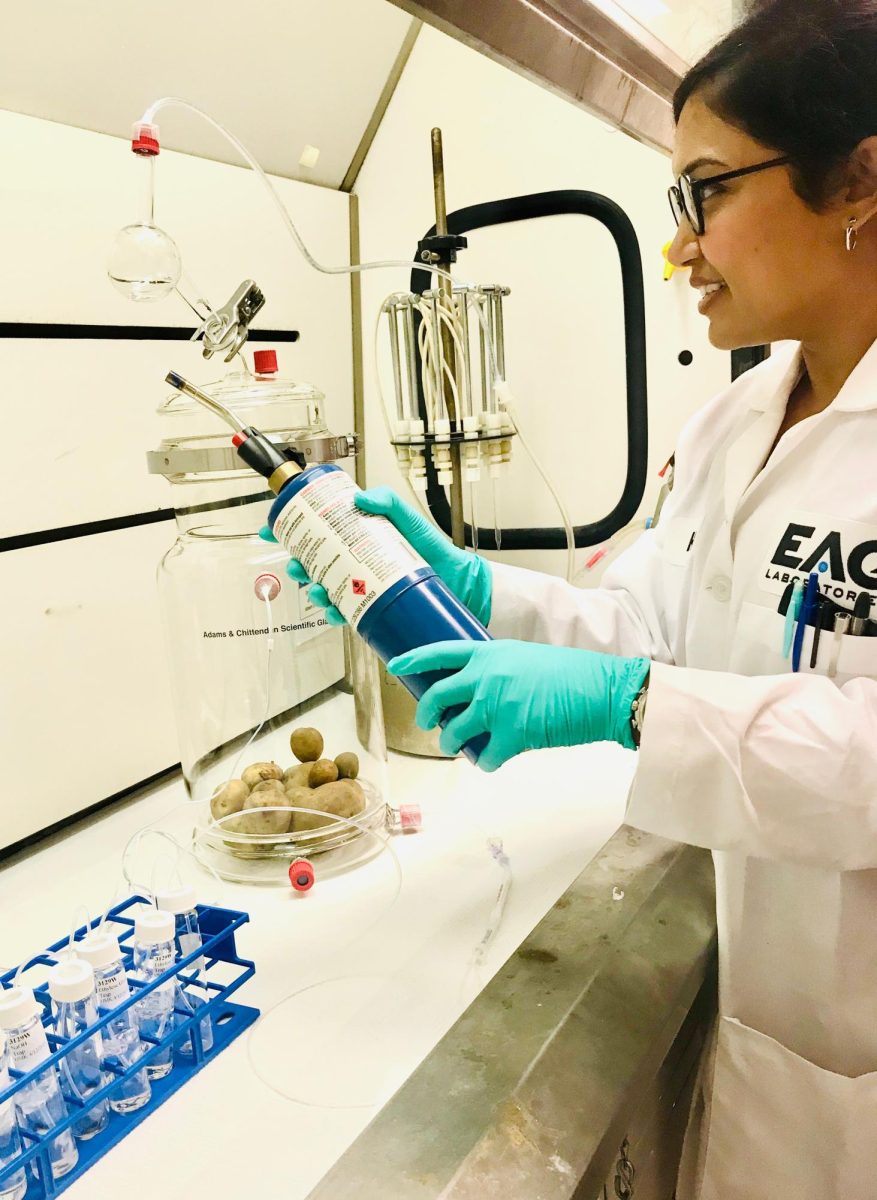
Hiranmayee Kandala received her doctorate in philosophy in analytical chemistry from SDSU and is now a principal scientist at Amgen, a biopharmaceutical company based in San Francisco. Kandala’s daily work consists of testing pharmaceuticals in the pre-clinical stage, before they move on to human trials.
Kandala looks fondly on her time at SDSU.
“I think the South Dakota State University times were the best times of my life,” Kandala said.
In addition to her Amgen work, she also “has a calling” to give back to the science community, she said. Kandala serves as an editor for the Drug Metabolism Reviews, Pharmacology Research and Perspectives and Drug Metabolism and Disposition.
Additionally, she is the chair for the IQ Consortium research group on Acyl Glucuronide, along with being a member of another research group and judging posters for the American Society of Pharmacology and Experimental Therapeutics.
Kandala was born and raised in India. She received her bachelor’s degree and her master’s in microbiology, biotechnology and bioinformatics from Osmania University in India.
After a competitive selection process, Kandala was accepted into her second master’s program at Western Kentucky University, where she received a master’s in chemistry. While talking with a professor at WKU, she was directed to apply for Professor Emeritus James Rice’s lab at SDSU, and was accepted.
But during her first year in the program, she fell in love with the projects in Professor Emeritus Douglas Raynie’s lab. Raynie became her doctoral adviser. Her dissertation involved isolating lignin, which is the basically the ‘glue’ that holds plants together, and converting it into sustainable jet fuel using ionic liquids as the solvents.
This was the first time the lab had done any sort of project like this, which led to many discoveries and new collaborations.
When she first started her dissertation research, Kandala’s plan was to be an analytical chemist. But by the end, she said she was “kind of an investigator.”
“There are times when you’re actually working on your dissertation, and you’re going on one path, and then you come across so many hurdles that will actually shape your path,” Kandala said.
The beginning of the program was filled with rigorous courses on becoming a teaching assistant and selecting her research projects.
“We used to hardly sleep for more than four or five hours. There was so much to do,” Kandala said. “By the end of those two months, we all became really confident in handling a lot of things.”
As her doctoral adviser, Raynie describes Kandala as a diligent student who would make strong progress in her research without much guidance.
“She immediately worked independently and was able to think critically and solve technical problems, skills that sometimes take students a year or more to develop,” Raynie said.
Raynie notes that despite the challenges Kandala faced, her teamwork and communication skills allowed her to overcome these challenges.
In addition to her dissertation, she also created a calculator for finding the acidic content of compounds, and was a teaching instructor and had an internship at South Dakota Agricultural Labs.
She was also deeply involved in campus life as the president of the Indian Student Association, the ex-officio of the International Relations Council, and a member of Golden Key International Honor Society, Gamma Sigma Alpha and the American Chemical Society while at SDSU.
After completing her doctorate, she worked at a few companies before coming to Amgen. Amgen was her dream company since her master’s program at Osmania University. However, she was hesitant to apply because she loved the company she was at.
“At every point, I was telling myself ‘don’t move, don’t move,’ but Amgen is a great place to work,” Kandala said.
When she was little, Kandala wanted to be an astronaut. This dream later shifted into her plan to become a scientist. What stayed consistent was her desire to be a successful woman in the STEM fields.
Her advice to other women pursuing scientific careers is to trust their voice and know their value. She wants them to understand that they belong in every space where ideas are being shaped, and that they are more than capable.
“Don’t wait until you feel perfectly ready to take the next step,” she said. “(It) begins the moment you step outside of your comfort zone.”
Kandala also offers practical encouragement to all students in tough courses. She strongly stressed that students have perseverance, do everything little by little, and ask so many questions.
“I’ve learned that success in STEM isn’t just about technical skills. It’s about perseverance, curiosity and community,” she said.
She stresses that college is the time to ask the questions, make mistakes and explore the scientific questions that one is wondering about.
“A lot of unmet medical needs in this world are being solved because somebody, somewhere, asked a question,” Kandala said.
Last, Kandala wants students to remember that being challenged academically is a privilege. Every successful person has had points where they wanted to stop and give up, but chose to keep pushing. She wants current students to do the same.
“If it is easy, it’s not for you,” Kandala said.
