











The College of Agriculture, Food and Environmental Sciences is launching a new master’s program that will give students a chance to have a deeper understanding of leadership and how it relates to agriculture.
The master of science in global agricultural leadership is designed to prepare the next generation of leaders. The program is set to start summer 2026 with applications for the first cohort due Feb. 15.
“This program is to prepare the next generation of leaders,” said Rosie Nold, assistant dean and director of global agricultural leadership. “It’s really about leadership in agriculture and having the foundation in all aspects of sustainability.”
This program is designed to enhance student leadership skills and economic awareness in a complex global agricultural environment, according to Nold. Graduates will be prepared to advance agriculture, strengthen rural communities and serve as leadership within agricultural systems worldwide. This sets graduates up to excel both their own careers as well as what they give back to agriculture communities.
The one-year, non-thesis program consists of 30 credit hours, with domestic and international travel. It’s a shorter program than traditional graduate programs. The structure allows students to pursue advanced education while gaining experience, Nold said.

Joe Cassady, South Dakota Corn Endowed Dean of Agriculture, Food and Environmental Sciences, said now was the right time to launch the program because agriculture needs strong leadership at every level, from local school boards and county commissions, to state and national government.
Required coursework includes classes focusing on leadership, economics and global agricultural systems. Students will begin the program in the summer with primarily online coursework and a leadership-focused internship and travel in early August to the West Coast. This gives students the opportunity to explore agriculture and leadership in different regions of the country.
Fall coursework includes advanced managerial economics and global climate change, along with international travel. In the spring, students complete classes in farming and food system economics, agricultural policy, management and leadership in technical organizations, and a capstone experience that applies leadership.
The goal of the program is not necessarily to turn students into leaders, Cassady said, but to help people who already demonstrate leadership potential advance more quickly into leadership roles.
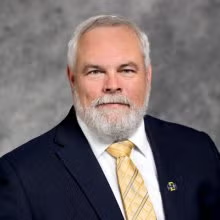
Ella Stiefvater, who recently applied to the program, said its focus on leadership and global experience caught her attention. Originally from Salem, S.D., Stiefvater is currently majoring in agricultural communications with a minor in animal science. She’s held several leadership roles on campus.
“I felt like this was an incredible opportunity to get in on the ground floor,” Stiefvater said. “It’s super appealing that the program will work with a full-time job and allow students to bring an industry perspective into leadership.”
Stiefvater first learned about the program through Nold and Bob Thaler, distinguished professor and SDSU Extension swine specialist. After traveling abroad to Vietnam, Stiefvater wanted to learn more about agriculture overseas.
The trip abroad will help students see agriculture beyond their own communities, Nold said. This will help bring real world experience to the classroom and work force.
SDSU plans on enrolling approximately 20 students per year in the program with a goal of about a dozen students for the first cohort. Students will benefit from strong industry support in this program and scholarship opportunities.
About $5 million was raised through the SDSU Alumni & Foundation to help launch and sustain the program. Commodity groups, private businesses and individual donors have contributed, and continued industry support will be key to the program’s long-term success.
“We have tremendous industry support behind this program,” Nold said. “So, I think there will be even greater opportunities to connect with industry leaders.”
While many applicants have undergraduate majors in agricultural business, animal science, agricultural leadership or communications, Nold said students from any major who are passionate about agriculture and leadership are encouraged to apply.
Stiefvater fits the bill when it comes to passion in agriculture and leadership.
“This sounds like such an incredible opportunity that is so perfectly timed being only one year, and you’re able to pack so many experiences in that one year,” Stiefvater said. “I would encourage students because we are young and we have our whole career ahead of us.”
“I am excited about the program and I am confident that those who choose to pursue this degree will be better prepared for success,” Cassady said.
The priority application deadline for the master of science in global agricultural leadership program is Feb. 15. Students can apply through the SDSU general graduate school application and by selecting the program.
Correction: The start date of this program was incorrectly stated in this story, which was published Feb. 3, 2026. The master of science in global agricultural leadership starts in the summer 2026 term.