














The nursing program at SDSU has had an increase in student enrollment, including both the prenursing and professional nursing program.
“We’ve seen a 6% average increase in our professional nursing program over the last four years,” said Marie Lohsandt, director of Nursing Student Services at SDSU.
There are several reasons why there has been an increased number of nursing students, according to Lohsandt. High job security, high demand and appreciation for the profession have all contributed to this increase.
During the 2025 fall semester, there were around 560 prenursing students, according to Dr. Mary Anne Krogh, the Roberta K. Olson Endowed Dean of the College of Nursing at SDSU. This is around 50 more students than the 2024 fall semester.
The continued growth of the nursing program and increased student enrollment fulfills workforce demands, Lohsandt said. Along with the high demand in the workforce, there are many career advancement opportunities in nursing and attractive earning potential.
“I really like to work with people,” sophomore Madalynn Feikema said, when asked about why she chose to pursue nursing.
Fiekema said nurses can make a large impact on patients.
“They’re so calm and helpful,” Feikema said.
This January, Feikema started the professional nursing program at the Brookings main campus location. She is most excited for clinicals and having hands-on experiences, she said.
Feikema noted that one of the reasons she chose SDSU was because of the high NCLEX pass rates and strong reputation of the nursing program. The NCLEX is the National Council Licensure Examination for Registered Nurses.
As of 2024, SDSU’s pass rate was 95.17%, according to sdstate.edu. This compares to the national average of 91.2% for first time United States educated students, according to the National Council of State Boards of Nursing in 2024.
Feikema said she heard several good things about the program’s academic reputation by just “word of mouth.”
Another draw for students is that SDSU has multiple program locations throughout the state, according to Lohsandt. There are locations in Brookings, Rapid City and Sioux Falls, with standard, accelerated and online programs.
This year, the Rapid City site set a record for having the largest class since it opened, Lohsandt said.
“The large amount of our growth has come because of our ability to provide more space for nursing education in Rapid City,” Krogh said. “Until a few years ago, we could enroll about 100 nursing students per year in Rapid City. Now we have the capacity to admit more than 200 students per year.”
Krogh explained that a majority of the growth in the nursing program has come from the SDSU Rapid City professional nursing program expansions. The increase in student numbers requires more resources, and Krogh said the university was awarded a $4 million dollar grant to help with growth, particularly in Rapid City.
The grant was awarded from the Health Resources and Services Administration, an agency of the U.S. Department of Health and Human Services. The grant is called the Nurse Education Practice Quality and Retention – Workforce Expansion Program, and gives SDSU four years with funding of $1 million per year.
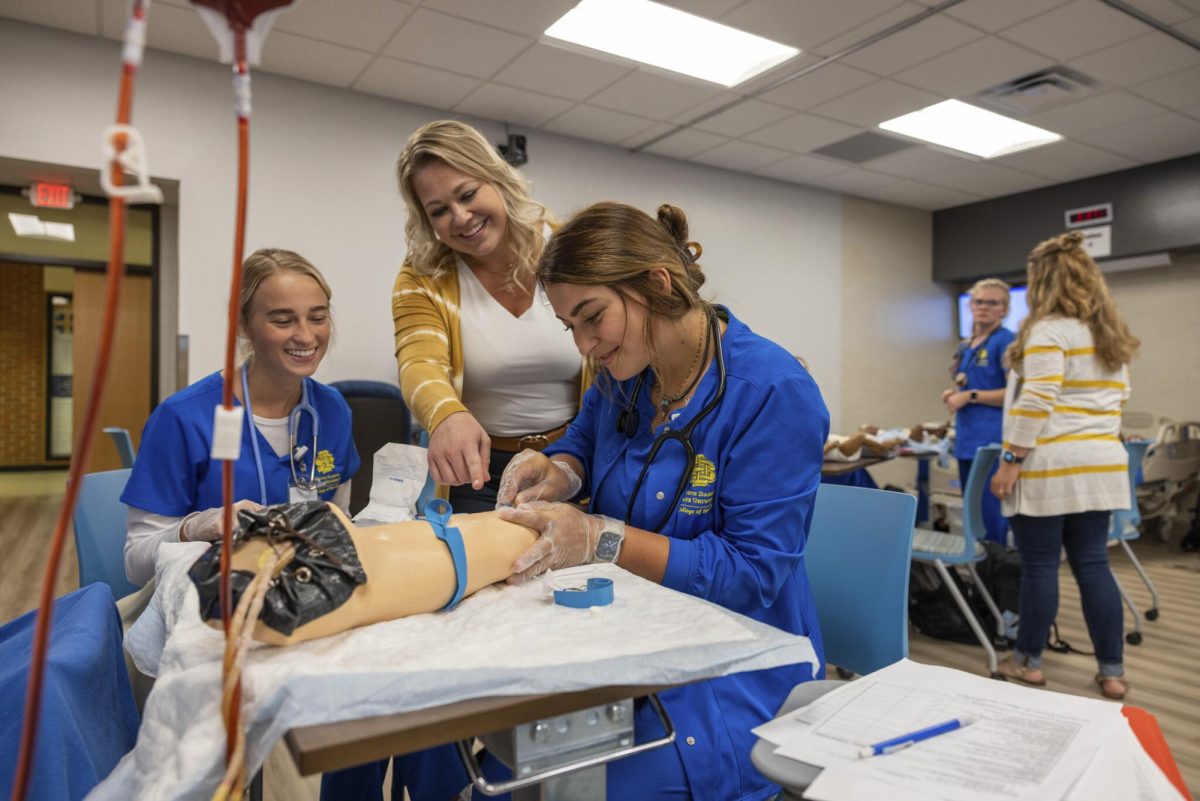
In the past few years, there also have been a few changes in the nursing program, including an accredited simulation center and a new competency-based curriculum.
In Sioux Falls, renovations to a building called the Metro Center is nearing completion. Krogh said because of the generosity of Avera Health, the Sioux Falls location will have “the opportunity to grow,” with the new space.
With these growing programs, there will also be a growth in faculty and staff to support the student enrollment, Lohsandt said.
“We really look at nursing education as a partnership between faculties, students and staff, and trying to help people achieve their dreams,” Krogh said.
Feikema said advisers have been helpful with keeping students organized and making sure they meet all of the necessary requirements. She said the advisers make it “a lot less overwhelming.”
Krogh said the reason why the pre-nursing program is so strong is because of the faculty in other SDSU departments.”
“If students didn’t come with a really strong science and writing and communication background … we wouldn’t be able to have such high-quality graduates in the end,” Krogh said.
Some challenges that occur with the growing nursing program include limited acceptance because of space constraints. Lohsandt said clinical placement is a challenge.
With more students, more personnel and space is necessary. Krogh said the nursing program is always changing, “because if you’re not moving forward, you’re going backwards.”


