















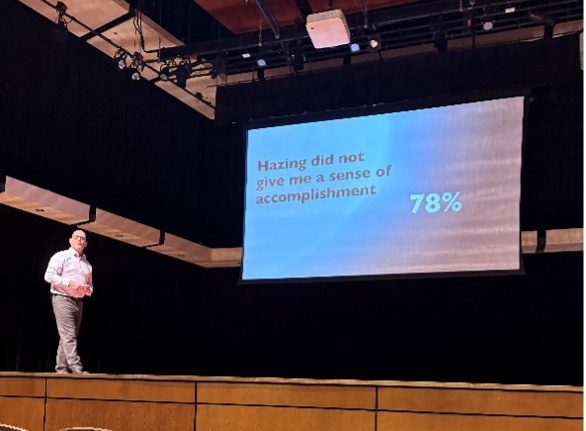
An SDSU audience filled with fraternity and sorority members listened last week as a veteran on the college-speaking circuit told them that hazing doesn’t build brotherhood or sisterhood – it destroys it.
“Hazing doesn’t make you stronger, it makes you smaller,” speaker David Stollman said. “You all deserve better than that.”
The event on Oct. 16 in the Larson Memorial Concert Hall, titled “Hazing Works and Others Lies,” was organized and promoted by the University Program Council. Stollman, who has spent over two decades speaking on college campuses about leadership and prevention issues, encouraged students to take a second look at traditions they accept as “normal” in their organizations.
“The truth will set you free, but first it will piss you off,” Stollman said to the audience, quoting his personal motto as laughter filled the theatre room.
In three separate years – 2002, 2009 and 2019 – there were 10 hazing-related deaths each year on U.S. college campuses, Stollman said.
“That’s just what’s documented,” he told students. “The real number is likely higher because not every incident is noticed as hazing.”
Stollman started the event with an “adjective test,” encouraging students to participate and “loosen up.”
But the event soon turned serious as he transitioned to what hazing really means, both under South Dakota law and South Dakota State University policy. Volunteers from the audience participated by reading definitions out loud in exchange for scratch-off lottery tickets, Stollman’s way of keeping the students engaged.
Under state law, he noted, anyone who commits hazing that ends up with a serious bodily injury is guilty of a felony.
“Consent doesn’t matter,” Stollman said. “It doesn’t matter if someone says, ‘We wanted this.’ It’s still hazing.”
SDSU’s policy, he explained, goes ever deeper, listing acts like sleep deprivation, physical confinement, forced consumption of substances or any activity that causes fear or goes against university rules.
“When you really look at those words, some of the stuff that’s been brushed off as ‘tradition’ fits right in there,” he said. “It’s not about intent, it’s about impact.”
Stollman said that while hazing and bullying are abusive, there are differences. Bullying, he said, keeps people out, while hazing is used to bring others in. Both can cause serious issues.
“Bullying is outward. Hazing is inward,” he said. “It’s meant to make someone ‘earn’ their place, but it’s just as dangerous.”
Throughout his presentation, Stollman explained real-life cases of hazing incidents that ended in tragedy, from fraternity rituals to athletic team initiations to marching band ‘traditions.’
“People call it a tradition,” Stollman said. “But those so-called traditions are killing people. And the people who could have spoken up always wish they had.”
Jake DeNomme, a member of Sigma Alpha Epsilon, said Stollman’s presentation meant a lot to him.
“It made me question what we call tradition,” DeNomme said. “Sometimes it’s easy to say, ‘That’s how it’s always been.’ But from now on, I (will) remember that being a good brother means protecting each other, not testing how far we can push someone.”
DeNomme said that hazing doesn’t build unity, it creates division and mistrust.
“The weaponization of alcohol is what’s killing students,” he said.
He also described how Stollman’s moments of humor helped deliver a difficult message.
“When he told the stories of students who lost their lives, you could feel the room get quiet,” DeNomme said.
Stollman’s talk also included a segment to help fraternities and sororities more effectively recruit for their organizations.
Stollman ended his speech with ideas about how groups can build belonging through psychological safety. He said that teams grow when every member feels included and respected.
“Real brotherhood and sisterhood come from listening,” he said. “Not from power trips or secrets.”
He stood on 10 toes telling the audience members to hold each other accountable and to not forget that their letters and organizations represent more than themselves.
“Those aren’t your letters; you’re holding them for the people who come after you,” he said. “Leave them better than you found them.”
After a round of applause, students stayed to talk about what they learned. For Stollman, he said he met his goal when he saw students discussing such a tough and emotional topic.
