












May is a busy month for college students: final exams, moving back home for the summer, the start of seasonal internships that (hopefully) will blossom into full-fledged careers and the triumphant blaring of “Pomp and Circumstance.” For one group of Jackrabbit seniors, however, last May held even more excitement than usual.
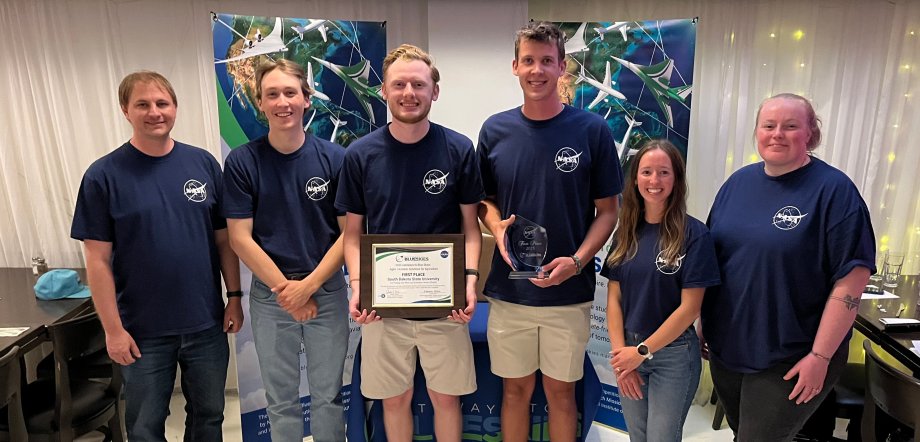
South Dakota State University students claimed first place in May at NASA’s Gateways to Blue Skies contest in Palmdale, California, beating out the seven other universities that made the finals.
The theme of the competition was AgAir: Aviation Solutions for Agriculture. Each team was tasked with creating an aviation-based concept that would assist in efficiency, production, severe weather and environmental impact in agriculture by the year 2035 or sooner. SDSU’s Soil Testing and Plant Leaf Extraction drone, or STaPLE for short, ultimately crowned them the top step of the podium.
Todd Letcher, associate professor in mechanical engineering and the adviser for this project, said the 4-foot-by-4-foot GPS-operated drone has three pointed ends that penetrate the soil and collects data, as well as a robotic arm that carefully grips and snips a plant’s leaf. Agronomists use the data from these soil tests and tissue extractions in numerous ways, such as identifying what crops to rotate into a certain field, what fertilizer would work best on given sections of a field and if diseases or fungi are growing within the crops.
The aviation and agriculture-focused theme of the 2025 competition piqued Letcher’s interest because he recognizes the strengths and interests of SDSU’s programs, as well as its students. The four students – Nathan Kuehl of Westbrook, Minnesota, Keegan Visher of Excelsior, Minnesota, Laura Peterson of Fredericksburg, Virginia, and Nick Wolles of Dell Rapids, South Dakota, took Letcher up on the challenge.
The four seniors began theory-crafting the project during the fall 2024 semester and dedicated the spring semester to building the prototype. The team submitted their proposal for the competition in mid-February.
“We submitted (the proposal), we thought we had a pretty good idea, but I don’t know if any of us thought we actually would be a finalist in this competition,” Kuehl said. “It felt really good after all that hard work that we put in last semester and a half to actually be selected and get flown out to California.
But the group’s fairytale story did not end with just a finals nomination. After arriving in California and delivering an impactful presentation to the judges, they were selected as the first place overall winner of the 2025 NASA Gateways to Blue Skies Competition.
Letcher credited a key factor of the team’s success as their time working in tandem with another SDSU program: National Science Foundation Innovation Corps, or NSF I-Corps.
Letcher said the NSF I-Corps is a process that ensures a product being designed is a product people want. Consultations with 30 farmers, agronomists and regional agricultural experts during the brainstorming phase of the project showed a common need: that soil testing and tissue sampling take too much time and are far too imprecise.
This in-depth research helped cement the Jackrabbits in their first overall placing.
The Jacks also got to enjoy the best the Golden State has to offer, as the trip included time for them to go sightseeing. Kuehl enjoyed seeing the Hollywood Walk of Fame and touring NASA Armstrong Flight Research Center during this “mini-vacation.”
Their biggest takeaway from this adventure, however, was not the Californian skyline, or even their first place finish but rather their feeling of pride and confidence they gained from this experience.
Kuehl said the team felt a boost in confidence after their initial presentation. They went from feeling like a small, midwestern school who was just happy to be there to feeling honored to win this prize for SDSU.
“That night we found out we won the whole competition, and that was just such a big confidence boost for us,” Kuehl said. “The feeling to bring home first place for South Dakota State was actually really cool.”
Letcher, who knew the team had something special from the start, was glad to see his team finally come around to this idea, as well. Letcher has advised teams for similar engineering projects in the past on a national level, which meant he had seen firsthand what he calls “Midwest modest mentality.”
When competing on a national level with larger schools, smaller schools from the midwest such as SDSU often feel as though their work is subpar, simply because of their geographical location or enrollment numbers. Letcher’s experience of bringing previous teams to various national competitions taught him the truth: that just because they are from a smaller place does not mean their work is not as impressive, and he was glad this team was able to see that, too.
Future of the Project
Today, the four nationally awarded seniors have graduated and moved on to the next chapters in their lives. Kuehl, for example, is working in Sioux Falls, South Dakota, as a control system specialist for Climate Systems.
This doesn’t mean the team’s concept and prototype will die out.
This fall semester, Letcher has a wave of younger students who have experience in similar NASA-based engineering competitions who have expressed interest in picking up where the now-Jackrabbit-alumni left off, as well as students who are potentially interested in participating in 2026’s Gateways to Blue Skies Competition. On top of that, Letcher also estimates there will be 50 to 60 new members of the Aerospace Club, most of whom are freshmen.
The increased interest in engineering opportunities at SDSU keeps Letcher hopeful that one day, the STaPLE drone may become normal practice for the agricultural world, and that last semester’s big success in California will not be a one-off story. But for this to happen, his hopes lie in the next generation of Jackrabbits, who he urges to get involved.
“If we’ve got people who are excited who are younger and want to join a team like this, we’ll take them and they can make very meaningful contributions to the team,” Letcher said.
“Even if they don’t know anything yet,” he added, “we didn’t know anything when we started, and the sooner you start, the smarter you get.”


